How the Best IVF Doctor in Gachibowli Supports Couples Through IVF Treatment
 |
| IVF Journey |
Understanding the IVF Journey
For many couples, the decision to begin IVF treatment comes after months or years of trying to conceive. The journey can involve medical investigations, fertility medications, regular monitoring, laboratory procedures, and important decisions about embryos and pregnancy. Along with the medical side, couples may also experience uncertainty, anxiety, hope, and emotional pressure.
This is why the role of a fertility specialist is much broader than simply performing an IVF procedure. A good fertility doctor helps couples understand why pregnancy may not have occurred, evaluates both partners, explains available treatment choices, creates an individualized plan, monitors the response to treatment, and guides the couple through each stage.
When people search for the Best IVF Doctor in Gachibowli, they are often looking for more than a doctor who can provide IVF. They want someone who can understand their individual situation, communicate clearly, provide evidence-based treatment, and support them through the different stages of fertility care.
At MOM IVF, we understand that every couple’s fertility journey is different. Our approach focuses on understanding the individual medical situation before recommending a treatment pathway. The goal is to provide personalized fertility care while helping couples understand what to expect at every stage.
What Does an IVF Doctor Actually Do?
An IVF doctor is a fertility specialist who evaluates and manages reproductive problems and provides assisted reproductive treatments when appropriate. IVF is one of several fertility treatment options, and the doctor first determines whether IVF is suitable for the couple.
The fertility specialist may assess ovulation, ovarian reserve, fallopian tubes, uterine health, sperm parameters, previous pregnancies, previous fertility treatments, medical conditions, and other factors that may influence conception.
Based on this information, the doctor can discuss possible treatment options. Depending on the diagnosis, these may include fertility medicines, timed intercourse, IUI, IVF, ICSI, embryo freezing, frozen embryo transfer, fertility preservation, or other appropriate approaches.
The treatment plan is therefore not simply about choosing IVF. It is about choosing the right approach for the right patient at the right time.
The First Consultation: Where Personalized Care Begins
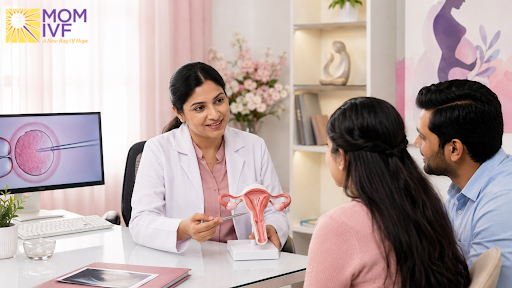
The first consultation is one of the most important stages of fertility treatment. It gives the doctor an opportunity to understand the couple’s reproductive history and gives patients an opportunity to understand their options.
The fertility specialist may ask about menstrual cycles, previous pregnancies, miscarriages, surgeries, medical conditions, medications, previous fertility investigations, previous IVF or IUI treatments, and how long the couple has been trying to conceive.
Male fertility is also evaluated because infertility may involve male factors, female factors, both partners, or unexplained causes. Semen analysis is commonly used to assess important sperm characteristics.
A detailed consultation helps prevent treatment decisions from being made without enough information.
Important Benefits of a Detailed First Consultation
- It helps identify possible fertility factors before treatment begins: Understanding the couple’s medical and reproductive history can guide the doctor toward appropriate investigations rather than immediately recommending an advanced procedure.
- It allows both partners to participate in the evaluation: Fertility problems can affect either partner, so assessing both partners when appropriate can help avoid delays in diagnosis and treatment.
- It gives couples an opportunity to understand their choices: Patients can ask about different treatments, expected timelines, possible risks, costs, and what may happen after each stage.
- It helps create realistic expectations: IVF can provide an important treatment option, but it cannot guarantee pregnancy. A responsible fertility specialist discusses both possibilities and limitations honestly.
Evaluating Female Fertility Before IVF
Before beginning IVF, the doctor may evaluate several aspects of female reproductive health. The exact investigations depend on age, medical history, symptoms, previous treatment, and clinical findings.
The evaluation may include assessment of ovulation, ovarian reserve, the uterus, and fallopian tubes. Ultrasound examinations can help assess the ovaries and uterus. In selected cases, additional investigations may be recommended to understand the reproductive system more clearly.
Ovarian reserve tests can provide information about the remaining egg supply and may help doctors plan ovarian stimulation. However, ovarian reserve should not be interpreted as a simple yes-or-no fertility test. A single test cannot predict the complete possibility of natural pregnancy or IVF success.
The fertility doctor combines test results with age, reproductive history, and other clinical information before developing the treatment plan.
Evaluating Male Fertility
Male fertility is an important part of the IVF evaluation. Problems with sperm production, sperm movement, sperm shape, or the reproductive tract can contribute to difficulty conceiving.
Semen analysis is commonly used to assess sperm concentration, motility, and morphology. If the initial result is abnormal, the doctor may recommend repeat testing or additional evaluation depending on the circumstances.
If male-factor infertility is identified, the treatment plan may be adjusted accordingly. Some couples may benefit from IUI, while others may require IVF or ICSI depending on the severity and nature of the sperm-related problem.
A complete fertility assessment therefore considers the couple as a unit rather than automatically placing responsibility on one partner.
How Age Influences IVF Treatment Planning
Age is an important factor in fertility care, particularly female age. Female reproductive potential generally declines with increasing age, and this can influence both natural fertility and assisted reproductive outcomes.
This does not mean that age alone determines whether IVF will work. Instead, age is considered alongside ovarian reserve, egg quality, sperm health, embryo development, uterine health, and other medical factors.
Women under 35 without known risk factors are generally advised to seek an infertility evaluation after 12 months of trying to conceive without pregnancy. For women aged 35 or older, evaluation is generally recommended after six months, while women over 40 may benefit from more immediate evaluation.
Earlier assessment may be appropriate when known fertility problems or risk factors are present.
This is why couples should not compare their treatment journey directly with another couple’s experience. Two people of the same age may have very different fertility profiles and may require completely different treatment strategies.
When IVF May Be Recommended
IVF can be considered for several fertility situations. The decision depends on the diagnosis and individual circumstances.
IVF may be discussed when there are blocked or damaged fallopian tubes, certain forms of male-factor infertility, endometriosis, reduced ovarian reserve, prolonged infertility, unexplained infertility in selected circumstances, or when previous fertility treatments have not achieved pregnancy.
However, IVF is not automatically the first option for every couple.
A fertility specialist may first consider less invasive approaches when appropriate. The recommended treatment depends on the couple’s age, fertility diagnosis, duration of infertility, previous pregnancy history, and previous treatment outcomes.
When couples compare IVF Centers in Gachibowli, they should ask why IVF is being recommended and whether other treatment options have been considered.
Creating a Personalized IVF Treatment Plan
Once the fertility evaluation is complete, the doctor can develop an IVF treatment protocol that fits the patient’s individual circumstances.
An IVF cycle generally involves ovarian stimulation, monitoring, egg retrieval, fertilization, embryo development, and embryo transfer or embryo freezing depending on the treatment plan.
The medication protocol may vary from one patient to another. Doctors consider factors such as ovarian reserve, age, previous response to stimulation, medical history, and previous fertility treatment.
The objective is not simply to use a larger amount of medication. The objective is to develop an appropriate stimulation strategy and monitor the response carefully.
What May Be Personalized During IVF?
- Medication selection and dosage: The type and amount of medication can be selected according to the patient’s reproductive profile and expected ovarian response.
- Monitoring schedule: Ultrasound and, when clinically appropriate, hormone testing help the fertility team understand how follicles are developing and whether treatment adjustments are needed.
- Trigger timing: The timing of the medication that supports final egg maturation is carefully planned according to follicular development.
- Fertilization method: Conventional IVF or ICSI may be considered depending on sperm factors, previous fertilization results, and other clinical circumstances.
- Embryo-transfer strategy: The timing and number of embryos considered for transfer depend on individual factors, embryo development, and clinical guidance.
Ovarian Stimulation and Monitoring
During an IVF cycle, fertility medicines are used to stimulate the ovaries so that multiple follicles can develop.
The response to stimulation varies between individuals. Some patients may respond strongly, while others may develop fewer follicles. This is why regular monitoring is essential.
Ultrasound examinations allow the fertility team to monitor follicular growth and assess the ovaries. Blood tests may also be used when clinically indicated.
Based on the response, the doctor may modify medication or adjust the timing of the next step.
This monitoring process is one of the important ways an IVF specialist provides personalized care rather than simply following a fixed schedule.
Egg Retrieval and Laboratory Fertilization
When the follicles reach the appropriate stage, egg retrieval is performed using a medically guided procedure.
The retrieved eggs are then transferred to the embryology laboratory, where they are assessed and prepared for fertilization.
Sperm is also collected and prepared according to the treatment plan. Depending on the patient’s circumstances, conventional IVF or ICSI may be used.
In conventional IVF, eggs and sperm are placed together under controlled laboratory conditions. In ICSI, a selected sperm is injected directly into an egg.
The choice between these techniques should be based on clinical and laboratory considerations rather than assuming that one method is automatically superior for every patient.
Embryo Development and Embryology Care
After fertilization, embryos are monitored as they develop in the laboratory.
Embryologists assess embryo development according to established laboratory criteria. Their role is essential because IVF is not only a clinical procedure; it is also a laboratory-based treatment.
The fertility specialist and embryology team work together to determine the next stage of treatment.
Depending on the situation, an embryo may be considered for transfer, freezing, or additional assessment according to the treatment plan and applicable medical guidance.
When choosing among IVF Centers in Gachibowli, couples should therefore consider not only the fertility doctor but also the embryology laboratory and the systems supporting embryo care.
Understanding Embryo Transfer
Embryo transfer involves placing an embryo into the uterus using a specialized catheter.
The timing of embryo transfer may vary depending on the treatment strategy. Some patients may have a fresh transfer, while others may have embryos frozen for a later frozen embryo transfer.
The number of embryos transferred is an important clinical decision. Transferring multiple embryos can increase the risk of multiple pregnancy, which may carry additional risks for both mother and babies.
For selected patients, single-embryo transfer may be recommended to reduce the risk of multiple pregnancy while maintaining an appropriate chance of success.
The decision should always be personalized according to the patient’s circumstances and the advice of the fertility team.
What Happens After Embryo Transfer?
The period after embryo transfer can be emotionally challenging because couples may be eager to know whether pregnancy has occurred.
The fertility team provides instructions about medications, activity, follow-up, and the appropriate time for pregnancy testing.
Patients should avoid interpreting every physical sensation as a sign of pregnancy. Hormonal medications themselves can cause symptoms such as bloating, breast tenderness, tiredness, or mood changes.
The most reliable way to determine pregnancy is through the appropriate pregnancy test at the time recommended by the fertility team.
During this waiting period, emotional support and clear communication can be especially valuable.
How the Doctor Supports Couples When IVF Does Not Work
One of the most important responsibilities of a fertility specialist is supporting patients even when treatment does not result in pregnancy.
An unsuccessful IVF cycle can be emotionally difficult. Couples may feel disappointed or confused and may immediately wonder what went wrong.
The doctor can review the treatment cycle in detail. This may include ovarian response, number of eggs retrieved, fertilization results, embryo development, transfer details, and other available clinical information.
The next treatment decision should not automatically be to repeat the same cycle without review.
A new plan may be considered if the previous cycle provides information suggesting that a different approach could be appropriate.
Understanding IVF Success Rates
Many couples search for clinics based on advertised success rates. However, IVF success rates need to be interpreted carefully.
IVF outcomes can vary according to age, diagnosis, ovarian reserve, sperm factors, embryo development, treatment type, and other patient-specific factors.
A clinic’s overall success rate does not necessarily represent the expected result for an individual couple.
This is why responsible fertility counseling focuses on individual circumstances rather than making guarantees.
The Best IVF Doctor in Gachibowli should not simply promise success. Instead, a fertility specialist should explain the factors that may influence treatment outcomes and provide realistic information.
Why Communication Matters During IVF
IVF can involve multiple appointments, medications, procedures, laboratory stages, and waiting periods. Clear communication helps patients understand what is happening and why.
Couples should feel comfortable asking questions about medications, test results, procedures, embryo development, treatment costs, and possible outcomes.
Medical terminology can sometimes feel confusing. A good fertility team should explain complex information in language that patients can understand.
At MOM IVF, we believe informed patients are better prepared to participate in their treatment decisions. We encourage couples to discuss their concerns openly and ask questions whenever they need clarification.
Supporting the Emotional Well-Being of Couples
Fertility treatment can affect emotional well-being as much as physical health.
Couples may experience anxiety before procedures, stress while waiting for results, disappointment after unsuccessful treatment, or pressure from family and society.
Partners may also experience emotions differently. One partner may want to discuss the treatment frequently, while the other may prefer privacy or find it difficult to express emotions.
Maintaining open communication can help couples support each other.
Professional counseling may also be useful for patients experiencing significant emotional distress. Seeking emotional support is not a sign of weakness. It can be an important part of maintaining well-being during fertility treatment.
Lifestyle Guidance During Fertility Treatment
Lifestyle guidance may form part of a broader fertility-care plan.
Patients may be advised to focus on balanced nutrition, regular physical activity, healthy sleep, avoiding tobacco, limiting alcohol, and maintaining a healthy weight when appropriate.
However, lifestyle changes should not be presented as a replacement for medical treatment when infertility has an underlying medical cause.
Patients should also be careful with supplements and online fertility products. Not every product marketed for fertility has strong scientific evidence behind it.
Before taking supplements or changing prescribed medications, patients should discuss them with their healthcare provider.
Choosing the Right IVF Clinic in Gachibowli
Couples searching for IVF Centers in Gachibowli may find several options, but choosing a fertility clinic requires careful consideration.
The right clinic should have qualified fertility specialists, trained embryologists, appropriate laboratory facilities, clear treatment protocols, and patient-focused communication.
Factors Couples Should Consider
- Qualifications and experience of the fertility specialist: Understand who will manage the treatment and whether the doctor has appropriate training in reproductive medicine.
- Laboratory and embryology facilities: IVF depends on careful laboratory handling of eggs, sperm, and embryos, making embryology services an important consideration.
- Personalized treatment planning: The clinic should evaluate the couple’s individual circumstances rather than offering identical treatment protocols to everyone.
- Transparent information about costs: Ask what the treatment package includes and whether medications, investigations, embryo freezing, storage, or additional procedures involve separate charges.
- Realistic discussion of success rates: Ask how the clinic calculates its success statistics and whether the information is relevant to your age and treatment situation.
- Patient communication and support: Couples should feel comfortable asking questions and receiving clear answers throughout the treatment process.
Why Choosing a Fertility Specialist Matters
The relationship between a couple and their fertility specialist can continue for weeks or months, and sometimes longer if multiple treatment cycles are required.
A specialist should therefore provide more than technical treatment. Patients need someone who can interpret complex medical information, explain options, monitor treatment carefully, and help them understand what to expect next.
Choosing the Best IVF Doctor in Gachibowli should therefore involve looking at the complete fertility-care experience rather than focusing on a single claim or advertisement.
The right doctor should help couples understand their diagnosis and treatment choices while maintaining realistic expectations.
Our Patient-Centered Approach at MOM IVF
At MOM IVF, we understand that every fertility journey is unique. Some couples may be undergoing fertility evaluation for the first time, while others may have already experienced unsuccessful treatments elsewhere.
We begin by understanding the patient’s history and evaluating appropriate fertility factors. Based on the findings, our fertility team can discuss suitable treatment options and explain the reasoning behind the recommended approach.
Our goal is to make fertility treatment easier to understand. We believe couples deserve clear information about investigations, medications, procedures, embryo care, possible outcomes, and the next steps.
For couples researching IVF Centers in Gachibowli, personalized treatment planning and patient communication should be among the most important factors considered before beginning IVF.
What Couples Should Ask Before Starting IVF
Before starting treatment, couples should feel comfortable asking their fertility specialist important questions.
Questions Worth Discussing With Your Doctor
- What is the likely cause of our infertility?
- Do both partners need additional fertility testing?
- Why are you recommending IVF for our situation?
- Are there other treatment options we should consider first?
- What IVF protocol is being recommended and why?
- What medications will I need?
- How will my response to stimulation be monitored?
- What are the possible risks associated with treatment?
- How will fertilization be performed?
- How will embryos be monitored in the laboratory?
- How will the embryo-transfer plan be decided?
- What happens if this cycle does not result in pregnancy?
- What costs are included in the treatment?
Having these conversations can help couples feel more prepared and confident about their treatment decisions.
Taking the Next Step Toward Parenthood
Beginning IVF treatment can feel overwhelming, especially when couples are unsure about what lies ahead. The right fertility specialist can make the process easier to understand by breaking it into manageable stages.
The journey begins with evaluation. It then moves into treatment planning, medication, monitoring, egg retrieval, laboratory fertilization, embryo development, embryo transfer, and follow-up.
At every stage, the fertility doctor has an opportunity to provide guidance and answer questions.
For couples exploring IVF Centers in Gachibowli, the most important decision is not simply where IVF is available. It is choosing a fertility-care team that understands individual needs, provides appropriate medical evaluation, uses suitable treatment strategies, and communicates honestly.
At MOM IVF, we believe fertility treatment should be built around the individual patient. Our approach combines medical evaluation, personalized treatment planning, laboratory coordination, careful monitoring, and compassionate support.
The road to parenthood may look different for every couple, but personalized fertility care can help patients move forward with better understanding and informed medical decisions.
Frequently Asked Questions
1. What does an IVF doctor do?
An IVF doctor evaluates fertility problems, identifies possible causes of infertility, and determines whether IVF or another fertility treatment may be appropriate. The specialist also creates a treatment plan, monitors the IVF cycle, and guides patients through egg retrieval, embryo development, transfer, and follow-up.
2. How do doctors personalize IVF treatment?
Doctors consider factors such as age, ovarian reserve, medical history, sperm quality, previous fertility treatments, ovarian response, and embryo development. Based on these factors, the medication protocol, monitoring, laboratory approach, and embryo-transfer strategy may be adjusted for the individual patient.
3. Is IVF suitable for everyone?
No, IVF is not automatically suitable or necessary for every couple experiencing infertility. Some patients may benefit from medication, timed intercourse, or IUI, while others may require IVF because of specific fertility conditions. A fertility specialist can recommend treatment based on the couple’s individual circumstances.
4. Why is male fertility testing important?
Male-factor infertility can contribute to difficulty conceiving, so evaluating the male partner can be an important part of fertility assessment. Semen analysis provides information about sperm concentration, movement, and morphology. The results may influence whether treatments such as IUI, IVF, or ICSI are considered.
5. How long does an IVF cycle take?
The length of an IVF cycle varies according to the treatment protocol and individual circumstances. It generally includes ovarian stimulation, monitoring, egg retrieval, laboratory fertilization, embryo development, and embryo transfer or freezing. The fertility team provides a personalized schedule based on the patient’s treatment plan.
6. Does IVF guarantee pregnancy?
No, IVF cannot guarantee pregnancy, even when treatment is carefully planned. Outcomes can depend on age, egg and sperm factors, embryo development, uterine health, diagnosis, and previous treatment history. A fertility specialist can explain the factors that may influence an individual couple’s chances.
7. What should I look for when choosing a fertility doctor?
Look for appropriate qualifications, experience in reproductive medicine, personalized treatment planning, strong laboratory support, transparent communication, and realistic counseling about outcomes. It is also important to choose a doctor who makes you comfortable asking questions and discussing concerns.
8. Can IVF treatment be changed after it begins?
Yes, the treatment plan may be adjusted depending on how the patient responds to medication and what monitoring reveals. Doctors may modify medication, timing, or other aspects of treatment when clinically appropriate. This flexibility is one of the important parts of personalized fertility care.
9. What happens if the first IVF cycle is unsuccessful?
The doctor can review the complete treatment cycle to understand the ovarian response, egg retrieval, fertilization, embryo development, and transfer. Depending on the findings, the next cycle may use a modified approach. An unsuccessful cycle does not automatically mean that future treatment will be unsuccessful.
10. Why is the embryology laboratory important in IVF?
The embryology laboratory is where eggs and sperm are handled, fertilization occurs, and embryos are monitored during development. Embryologists work closely with fertility specialists throughout the IVF process. Therefore, laboratory expertise and infrastructure are important factors when choosing a fertility clinic.
Conclusion
IVF treatment involves much more than a single procedure. It is a carefully coordinated journey involving diagnosis, treatment planning, medication, monitoring, egg retrieval, fertilization, embryo development, embryo transfer, and follow-up.
The Best IVF Doctor in Gachibowli should be able to guide couples through these stages with personalized medical care, clear communication, realistic expectations, and appropriate treatment planning.
At MOM IVF, we recognize that every couple has a different fertility story. By understanding the individual medical situation and selecting treatment accordingly, we aim to provide a more informed and patient-focused fertility experience.
Couples searching for IVF Centers in Gachibowli should take time to evaluate the fertility specialist, embryology laboratory, treatment approach, communication, transparency, and overall patient support before beginning treatment.
The goal is not simply to provide an IVF procedure. The goal is to provide appropriate fertility care that helps couples understand their options and move toward their parenthood goals with informed medical guidance.

Comments
Post a Comment